

I wanted to go on an epic journey, away from crowded towns and noisy highways. I enjoy taking walks in the outdoors, and I had heard of the Manaslu Circuit trek Tour, also called Manaslu Round Trek, an amazing place in Nepal. It is quite and serene because not many people visit. I was much more eager to give it a try after that.
At beginning, I knew very little about this expedition. However, I knew I wanted to go here after seeing images of towering snow-capped mountains and small villages surrounded by rivers and trees. It had a unique, wild, and organic appearance. I wanted to experience the chilly wind, stroll alongside the mountains, and observe how people live in these remote communities.
I had a range of emotions before the trek. I felt a little anxious as well as thrilled. I had never climbed so high or walked so far. I was prepared to attempt, though. “Let’s go see something amazing,” I said to myself as I prepared my backpack and put on my hiking boots. This is the story of my Manaslu Circuit adventure. It was more than just a walk; it was a silent, lovely transformation.
A Long Road to the Beginning
Beginning the Manaslu Circuit Trek was an adventure in itself. With a rucksack full of necessities and a lot of excitement, I set out early in the morning from the busy streets of Kathmandu. Soti Khola, a tiny riverbank community that serves as the trek’s beginning point, was where I ended up. It took a jeep nearly eight or ten hours to get there. It was a rocky, dirty, and occasionally slow ride. However, it was the first time I saw Nepal’s countryside.
The more we drove from the city, the more things changed. Terraced fields stretched out like huge steps on the hillsides, waterfalls cascaded down cliffs beside the road, and the concrete buildings disappeared into green hills. We occasionally came into small communities with contented kids and modest dwellings. I let the fresh air in by rolling down the window. I had the impression that I was gradually escaping my everyday reality.
When we arrived to Machha Khola, the sun had already set, bathing the rice fields and river in a golden glow. With only a few teahouses, a suspension bridge, and the soft murmur of the Budhi Gandaki River running close by, the village seemed peaceful. I was ready for the actual journey to start, but I was also exhausted from the drive. I stayed at a small teahouse that evening. It was a simple room, with only a bed and a blanket, but comfortable. After the long journey, the dal bhat (Nepali rice and lentils) that was given for dinner tasted quite delicious.
First Steps on the Trail
I awoke the following morning to the gentle murmur of the river and the sound of birds. My first day on the trail was that day. I fastened my backpack, tied my boots, and walked across the suspension bridge for the first time. That’s what I recall thinking. I am doing this for real.
Beginning along the river’s bank, the trail occasionally passed through woods and at other points ascended and descended stony slopes. Monkeys played in the trees, waterfalls cascaded alongside the path, and occasionally mules with bells ringing softly went by with supplies.
The contrast between village life and city life was one of the first things that caught my attention. People were sitting outside talking to neighbors or working in the fields, drying grain in the sun. Life appeared to be simpler, slower, and closer to the natural world.
I also started to take note of how silent the route was. There were fewer trekkers than on the well-traveled Everest or Annapurna routes. At moments, I thought I had the entire mountain trail to myself. I had time to reflect, take a big breath, and truly take in my surroundings.
Leg aches but a joyful heart marked the end of that first day. The quiet, the scenery, and the pace of the walk had already won me over to the route. The Manaslu Circuit was just beginning, and I couldn’t wait to see what came next.
Narrow Trails and Endless River Sounds
The actual adventure of the Manaslu Circuit Trek started after leaving Machha Khola. We took daily walks by the fast-moving Budhi Gandaki River, which plunges far into the hills and mountains. We could always hear the river’s sound, whether it was loud and powerful or peaceful and serene. We had the impression that the water was interacting with us.
In numerous spots, the trail was narrow. Sometimes it was only a narrow trail dug into a cliff face. We had to travel with caution, particularly when mules or donkeys passed us with supplies for far-off villages.
The river was often crossed by suspension bridges. At first glance, these lengthy, swaying bridges were frightening, but they were sturdy. It was thrilling and amazing to walk on them with the river far below and the wind blowing.
Every turn on the trail offered a different view, whether it was youngsters waving from their yards, small villages with stone cottages, or waterfalls tumbling down rocks. It was pure beauty. No crowds were present. It was just the river, us, and the mountains rising slowly in the background.
Quiet Villages and Warm Welcomes
Along the trip, we made several stops in villages, including Jagat, and Deng. There are only a few tea places and basic stores in these tiny communities. However, their warmth more than made up for their lack of size. People smiled as they greeted us. Despite the fact that our languages were different, every gesture was friendly.
We stayed at a simple lodge in Jagat that has a beautiful garden and a view of the hills. I recall sipping tea outside that night while observing the sunset paint the sky pink and orange. The village felt old and peaceful because of its well-kept houses and stone-paved streets. We learned from a local woman how to say “namaste” correctly, which involves putting your palms together and giving a firm nod. That little lesson felt significant—a token of regard and friendship.
We saw fewer people the higher we climbed. The villages were farther apart and the air was colder in Deng. Nevertheless, each location offered a cozy stove, a basic bed, and a gracious host. After a long day of hiking, these minor conveniences felt incredible. The tea houses made us feel comfortable despite their lack of amenities.
A journey through Nepal’s natural beauty and calm way of life, walking along the Budhi Gandaki River was more than just a trail. My recollection was shaped by the tumbling river, steep cliffs, and cheerful locals. Though difficult, these climbing days taught me to calm down, pay attention, and enjoy each step.
Into the Heart of the Himalayas: Samagaun and Surroundings
After several days of trekking through deep valleys and winding paths, I eventually arrived in Samagaun, a tranquil village that rests peacefully beneath the majestic Mt. Manaslu,. I had the impression that I had arrived in the heart of the Himalayas at this point. I noticed that everything was quieter, colder, and more spiritual.
One of the largest communities on the Manaslu Circuit is Samagaun. High cliffs, expansive fields, and snowy peaks that appear to reach the skyline encircle it. Here, people lead basic lives that are closely linked to religion and the natural world. Local children played close to stone houses, prayer wheels whirled slowly in the wind, and Yaks walked through fields. It was as if you were entering a world that had not changed much over hundreds of years.
This part of the journey was important for acclimatization as well. We spent two nights in Samagaun to allow our body to acclimate to the greater elevation (about 3,500 meters). I was able to rest, think, and do a more thorough exploration of the area because of this stop.
Hike to Manaslu Base Camp: A Day I’ll Never Forget
I chose to go on a side hike to Manaslu Base Camp on the day we were off. The trail ascended rapidly through icy portions and rocky roads, making it difficult. Every move felt a little heavier than normal because of the thin air. But I continued because of the views. The scenery become more stunning as I ascended higher. Amidst the pristine white snow, prayer flags fluttered as glacier lakes sparkled in the sunlight.
Arriving at the base camp was a significant event. Standing at the base of Mount Manaslu gave me chills, despite the fact that I wasn’t ascending the peak. The mountain was robust, silent, and full with stories. I felt small but incredibly linked to something far larger as I stood still and gazed up at its icy face.
I recall just taking it all in while drinking tea from my thermos. It was more than just the scenery. It was about the trip there, the peaceful paths, the people I encountered, and the emotions the mountain evoked in me.
The Spirit of the Region: Culture, Monasteries, and Prayer Flags
I strolled around the village for a while after returning to Samagaun. Monks were chanting softly when I visited a little monastery. Butter lamps flickered softly in the dim light, while colorful paintings of Buddhist deities filled the walls. Inside, there was a deep sensation of calm.
Outside, the flutter of prayer flags and the ringing of bells were frequently carried by the wind. These flags were put up on rooftops, slopes, and bridges. Blessings spread throughout the area as each one carried prayers to the breeze. Even though I didn’t entirely understand every custom, I could sense how much the people there valued their culture and religion.
This section of the trek caused me to slow down. Walking wasn’t enough anymore. It has to do with hearing, seeing, and feeling. Samagaun made me understand that trekking is about making connections with people, places, and memories that will last a lifetime, not just about climbing high passes.
The Night Before the Pass: A Mix of Nerves and Excitement
I will always remember the night before we crossed Larke La Pass. We arrived at Dharmashala, a small and basic hotel situated in a windy and cold valley. It was simple, with thin walls, a few wooden rooms, and freezing air leaking in from all sides. However, it was what was to come that made the night feel so intense, not the location.
That night, everyone in the group appeared to be a little more reserved. The dining hall exuded a somewhat anxious vibe. We were aware that the most challenging portion of the journey would be the next day. At 5,160 meters, Larke La Pass is the highest point of the Manaslu Circuit. That is higher than a lot of base camps in the Himalayas. At three in the morning, we planned to get up and begin the ascent in the dark.
We received a briefing from our guide before sleeping. He advised wearing warm clothing because it would be really cold up there. Move slowly and keep your head down. Although the ascent is lengthy, the payoff is worthwhile. I made sure to include a water bottle, energy bars, additional gloves, and a headlamp in my backpack. The cold, the altitude, and most of all the excitement made it difficult to fall asleep that night. “Can I really do this?”, I kept asking myself.
The Climb to the Top: A Test of Strength and a Gift of Beauty
We started out in the dark. Just ahead of our boots, the snowy trail was illuminated by our headlamps. The thin air made every stride feel heavy, and the cold air sliced into my face. The sound of our boots crunching on the snow was the only sound to break the great calm as we moved carefully, one step at a time.
The sky began to become blue as we ascended higher. Gradually, the first rays of daylight started to illuminate the mountains surrounding us. When I turned back, I observed the long line of trekkers, who stood out against the white slopes like little figurines. We had the impression that we were walking on the edge of the world.
The hardest part was the last hour to the peak. Even though I was moving very slowly, I could feel my heart racing on the ice, steep slope. My breathing was rapid and my fingers felt numb. Suddenly, however, we arrived at the summit.
Numerous vibrant prayer flags were flying in the wind, and there was a small sign that read, “Larke La Pass – 5,160 m.” I let go of my rucksack, gave my guide a hug, and grinned silently. Massive peaks in all directions and vast valleys far below made for incredible views. I had never felt more alive, and it was windy and freezing.
I felt humbled and pleased as I stood there. I was pleased to have succeeded. I was humbled because I was only a little traveler walking through such vast and timeless mountains. Standing atop Larke Pass was the highest point of the journey, both in terms of elevation and feeling.
The Descent: Reflecting While Returning to Lower Trails
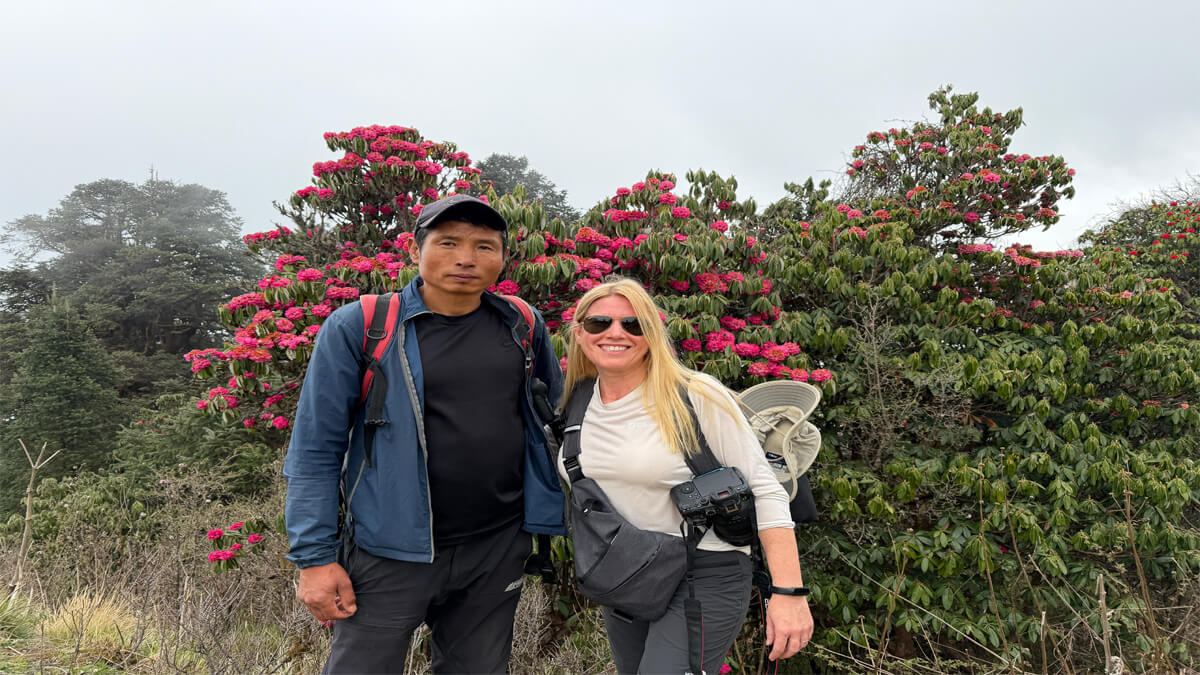
The trail began to change dramatically after crossing the high Larke La Pass. I was now out of the icy winds and sharp rocks of the high Himalayas. Once more, I was walking through forests, this time with towering pines, rhododendrons in bloom, and the sound of birds rather than snow and quiet. After the white world of the pass, the village of Bimthang seemed like a green valley of tranquility. I recall how delicious the plain dal bhat was during my one-night stay there. Perhaps it was because I had just finished one of the most difficult portions of the journey, or perhaps I was simply exhausted. In any case, it seemed like a little prize.
The trail got easier as I went downhill. Maybe I was filled with quiet happiness because my legs felt lighter even though they were hurting. I went by lovely villages like Tilije and Gho. The locals appeared surprised but friendly. Locals frequently waved or welcomed me with a “Namaste” and a smile, as fewer trekkers use this route than the Annapurna trail. Life here was calmer, more grounded, and more in tune with nature, I could tell.
I became aware of a difference in both the scenery and myself by the time I arrived at Dharapani, where the Manaslu trail connects to the Annapurna Circuit. Once more, there were larger guesthouses, more trekkers, and even Wi-Fi. Oddly enough, though, I missed the Manaslu region’s quiet trails and tiny villages. It was getting harder to feel like you were wandering with the mountains by yourself.
Goodbyes, Gratitude, and Looking Back
I began to experience a range of emotions as the walk came to a close. I was ready to relax physically. For almost two weeks, my legs traveled icy passes, rivers, and forests. I didn’t want it to end, though, both emotionally and mentally. On the Manaslu Circuit, each day had been an opportunity to learn about patience, simplicity, and awe.
It was difficult to say goodbye to my porter and guide. They were now like family. We had spent a lot of time together, laughing over modest dinners, supporting one another on challenging treks, and seeing the sunrise over snow-capped mountains. I gave them a little a reward and a heartfelt thank you, but the words didn’t seem like enough for what they provided me.
I saw the rolling hills outside the window as we drove back to Kathmandu. My heart was full, but my mind were quiet. Trekking the Manaslu Circuit was more than just a physical journey, I came to realize. I was able to reestablish relationships with people, the natural world, and myself thanks to this journey.
Silence became natural to me. Even on a difficult or unfamiliar path, I learnt to keep moving forward. Above all, I discovered that sometimes the journey back is when you realize how far you have come.
What the Manaslu Circuit Taught Me
The Manaslu Circuit trek was a spiritual and emotional adventure in addition to a physical one. There was a new lesson every day. Some were minor, such as learning to breathe more deeply and walk more slowly. Lessons about patience, thankfulness, and the beauty of simplicity were among the more significant ones.
A Lesson in Resilience
The trail has a lot of difficult days. The ascents seemed to go on forever, especially when a backpack was on. As we ascended, the air became thinner. I occasionally had poor energy and painful legs. But I continued. Breath by breath, step by step. I discovered that my body and, more significantly, my intellect are stronger than I had previously believed. I reminded myself why I started when things got difficult. I now take that strength into my daily life since it helped me go to Larke Pass with quiet determination.
The Beauty of Slowing Down
I am constantly rushing around the city, chasing time and rushing from one assignment to another. However, there was no rush on the Manaslu trail. The pace of life was slower and more organic. I had time to observe the shifting cloud forms, listen to the breeze, and watch the river run. I cherished simple moments, laughed over hot meals, and conversed with locals and other trekkers. I became aware of how much I had been missing because I was moving too quickly. I was reminded to stop and simply be present by this trek.
Gratitude for the Basics
I had very little on the trek, including no internet, no luxury food, and no daily hot baths. However, I never experienced unhappiness. After a long walk, a warm cup of tea felt like an offering. My heart was delighted with a clear glimpse of the snow-capped Alps. I felt more connected when I told the guide or the locals stories. I realized that our perceptions and experiences of the world determine our level of happiness, not material possessions. I got more appreciative of little pleasures as my comforts disappeared.
Respecting Culture and Nature
Life, tradition, and a strong sense of faith abound in the communities along the Manaslu Circuit. I witnessed farmers carefully tending to the land, monks chanting in historic monasteries, and people spinning prayer wheels. I learned to respect nature and their culture from their relationship with the land and mountains. I started to pay more attention to what I was doing, where I was going, what I was leaving behind, and how I was acting. The experience inspired me to travel more responsibly, empathetically, and thoughtfully.
A Quiet, Inner Change
One early, chilly, and quiet morning, I noticed a change in the atmosphere as I gazed up at Mount Manaslu. It wasn’t loud or dramatic. Deep down, it was a peaceful sensation, a feeling that I belonged here. I had learned something from the journey that I never knew I needed. Throughout it all, the mountains had been softly guiding me toward my potential.
This journey took me inward rather than merely around the Manaslu region. And in doing so, it showered upon me something enduring: courage, clarity, and a deep respect for Nepal’s natural beauty.
Practical Tips for Future Trekkers
Get in Good Shape Before You Go
The trek around the Manaslu Circuit is lengthy and occasionally rather steep. I discovered that being physically fit was really beneficial. I made an effort to walk every day before the trek, especially uphill. I prepared by hiking, stair climbing, or even just taking brisk walks while carrying a bag. The more fit you are, the more you will enjoy the trek without being overly exhausted.
Pick the Right Time to Trek
I believe that going in October, which is the fall season, was the finest choice. The trails were dry, the weather was clear, and the vistas of the mountains were breathtaking. With the rhododendrons in flower and the temps rising, spring (March to May) is also fantastic. Steer clear of the monsoon season (June to August) as landslides are frequent and the trails become muddy and slick. Particularly in the high passes, winter (December to February) can be extremely cold and snowy.
Pack Light, but Don’t Miss the Essentials
Packing sensibly is crucial. I packed thermal base layers, a windproof outer shell, warm layers, and a decent down jacket. It is also essential to have a sleeping bag that can withstand cold nights. Wet wipes, sunscreen, lip balm, hiking poles, a power bank, a torch, and water purification tablets were among the other helpful supplies. Don’t skip the wet wipes, I promise!
For me, it really made a difference to have good hiking boots that are already broken in. Additionally, remember to pack sunglasses, gloves, and a decent cap. The sun is intense and it becomes cold up there.
Hire a Guide (and Maybe a Porter)
My trip was greatly improved when I decided to hire a guide through Nepal Trekking Routes. My guide kept me safe during challenging portions of the trek, assisted with permits, described the local way of life, and was knowledgeable about the trail. To carry the majority of my equipment, I also employed a porter. I had more energy to enjoy the scenery and take a walk as a result. Additionally, using local porters and guides boosts the local economy.
Trek Respectfully
Numerous isolated mountain communities with a vibrant Tibetan culture can be found in the Manaslu region. People are conventional but kind. I learnt to always ask before taking pictures, talk properly, and dress modestly. It seemed unique to tour monasteries and watch prayer wheels spin, and showing respect made it easier for me to get along with the people. I made an effort to stay away from plastic bottles. Rather, I treated my water with tablets or a filter and used a reusable container. In addition to saving me money, it was better for the environment.
Expect the Unexpected
The weather might change suddenly. You may be powerful one day and exhausted the next. Hot baths are uncommon the higher you go, and the internet is unreliable or nonexistent in many spots. But really? Part of the magic was that. I began to appreciate each step more when I adapted to the simple rhythm of the trail.
FAQs
How long did it take you to do the Manaslu Circuit Trek?
With one day off for acclimatization in Samagaun and the last descent into Dharapani, the trek took me roughly 14 days.
Was it difficult to navigate the Manaslu Circuit?
Yes, the high altitude and steep climbs made it difficult, but it was manageable with planning, pace, and the assistance of a porter and guide.
What made the Manaslu Circuit Trek unique?
Far less congested than well-traveled routes like Annapurna, its serene trails, isolated villages, and Himalayan beauty gave it an unspoiled, intimate vibe.
Did the trek require a guide or a special permit?
Indeed, the Manaslu Circuit is a restricted area, therefore I required permits from a certified trekking service and a registered guide.
How was the weather and what season did you trek?
I went on my treks in October, which was ideal for high passes like Larke La because of the clear skies, comfortable temperatures, and breathtaking mountain views.
Conclusion: Manaslu Circuit Trekking Tour
Trekking to Manaslu Circuit felt like a peaceful exploration of who I am. Every step and breath in the thin air served as a reminder of how insignificant we are in relation to nature, yet how closely we can sense our connection to it. I didn’t know I was searching for tranquility, but the quiet strength of the Himalayas, their gentle paths, and their gentle people delivered it to me.
In addition to seeing the mountains, I came away with new friends, a stronger body, and a more peaceful mind. I will always cherish the memories of crossing Larke Pass, drinking tea in isolated communities, and witnessing sunrise on snow-capped summits.
Looking back, I recall walking with the mountains rather than simply walking through them. And that was the important aspect. I hope you take that initial step if you ever have the chance.

Leave a Reply